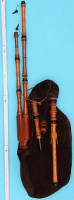
 Hümmelchen |
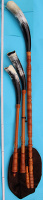 Großer Bock |
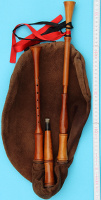 Schäferpfeife |
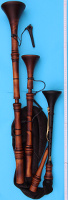 Marktsackpfeife |
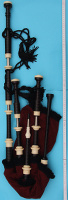 Great Highland Bagpipe |

Hier geht's zur deutschsprachigen Version
Go here to the German version
|
Bagpipe | Hier geht's zur deutschsprachigen Version Go here to the German version |
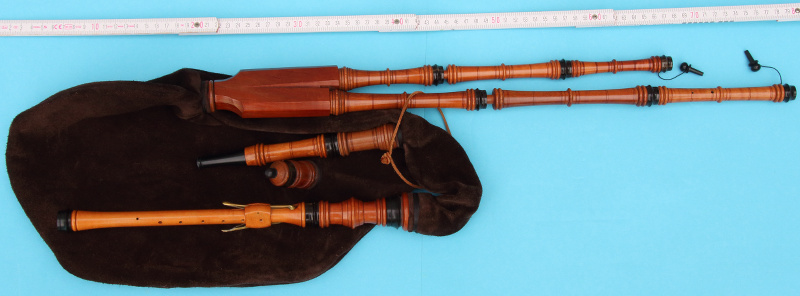
Bagpipe shown here, the "German small bagpipe" (ger.: Hümmelchen; means "small bumblebee"), is mouth blown or bellow blown and has a cylindrically bored chanter equipped with a double-reed and two cylindrically bored drones equipped with double-reeds. Its chanter has a scale range of c¹ d¹ e¹ – g² and is tuned up to tuning pitch a¹ = 440 Hz. This large scale range is enabled by two mounted keys. These keys are modern developments. Scale range of chanter ends at e♭² without key fingerings. Tones e², f² and f♯² are played with key fingerings. Key for tone e² is handled by left little finger. Key for tones f² and f♯² is handled by first phalanx of right forefinger. Tone g² is an overblown tone. Tone c¹ is fingered and additionally key for tone e² is opened to play this tone. Both drones are constructed to tune them to different tones, that's supported by used double-reeds. Long drone can be tuned to tones c⁰ and d⁰ by turning the upper section. A vent-hole is opened for tone d⁰ by turning. This drone can also be tuned to tone B starting from tone c⁰. Short drone can be tuned to tones f⁰, g⁰ and a⁰ by turning upper section. Vent-holes are opened for tones g⁰ and a⁰ by turning. This drone can also be tuned to tone e⁰ starting from tone f⁰. These tuning possibilities result in 20 different drone tunings. 13 out of them are musically useful:
The other possible tunings with both drones are useless in most cases. They can only be used for modern music in rare cases.
This instrument is equipped with plastic reeds.
Wooden parts of the instrument shown above are made of chequer tree wood. Mounts are made of plastic on chanter stock and lower end of the chanter. All other mounts are made of horn. Brass is used for keys. Bag is made of leather. An additional stock is bound into bag. A bellow can be attached on this stock. Non-return valve at blow pipe prevents air flow through blow pipe while playing bellow blown. Additional stock is closed with a stopper while playing mouth blown. This instrument is equipped with plastic reeds. This normally causes no problems for sound of bagpipes in difference to direct blown reed instruments. Plastic reeds shorten "warm blowing time".
Hümmelchens (with keyless chanters) are typical instruments of the Renaissance. They sound distinct softer than bagpipes with conically bored chanters. Chanter is always equipped with a double-reed. Drones can be equipped with double-reeds or single-reeds. If drones are equipped with double-reeds too, nearly no differences are between sounds of chanter and drones. This results in a very homogeneous sound of the instrument. German name Hümmelchen or Hummelchen goes back to a sound component of the instrument, that reminds one of flapping of wings of a bumblebee (ger.: Hummel). Hümmelchens with three or four drones are also called Dudey. Some modern Hümmelchens are build with only one drone. These instruments are chiefly designed for learners. Most common are soprano chanters. Sopranino chanters (lowest tone f¹), alto chanters (lowest tone f⁰) and tenor chanters (lowest tone c⁰) are build too.
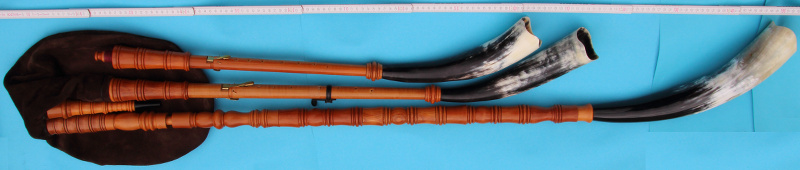
Bagpipe shown here, the "Großer Bock" (ger., means: great "bock" bagpipe), is mouth blown and has a cylindrically bored chanter equipped with a double-reed and one cylindrically bored drone equipped with a single-reed. Chanter and drone have larges bells made of horns. Tenor chanter has a scale range of c⁰ d⁰ – f♯¹ and is tuned up to tuning pitch a¹ = 440 Hz. Alto chanter has a scale range of f⁰ g⁰ – b¹ and is tuned up to tuning pitch a¹ = 440 Hz. This large scale range is enabled by two mounted keys. These keys are modern developments. Scale range of tenor chanter ends at e♭¹ without key fingerings. Tones e¹, f¹ and f♯¹ are played with key fingerings. Scale range of alto chanter ends at a♭¹ without key fingerings. Tones a¹, b♭¹ and b¹ are played with key fingerings. Keys are handled by left forefinger and left thumb. The drone consists of several sections. This construction enables tuning it to different tones. Section 1 keeps the single-reed and and is placed in drone stock. Drone is always tuned by moving section 2. Section 6 keeps the bell. Therefore sections 1, 2 and 6 are always used. Sections 3, 4 and 5 are inserted between sections 2 and 6 if needed. Two different sized single-reeds are available too. Possible drone tunings are listed below:
| C | long single-reed | + sections 1+2+3+4+5+6 (as shown above) |
| D | long single-reed | + sections 1+2+3+4+6 |
| E | long single-reed | + sections 1+2+3+6 |
| E | short single-reed | + sections 1+2+3+4+6 |
| F | short single-reed | + sections 1+2+3+4+6 |
| G | short single-reed | + sections 1+2+3+6 |
| A | short single-reed | + sections 1+2+6 |
Drone is tuned to tones E or F with short single-reed by moving section 2. All other drone tones require inserting or removing sections or changing the single-reed. Shorten drone tube increases overtone content of drone sound. Drone tone E with long single-reed and A with short single-reed sound with much overtones and are borderline cases for drone tones. It can be switched to drone tone E with short single-reed as an alternative to drone tone E with long single-reed. There is no direct alternative for drone tone A with short single-reed, but in many cases it's possible to use drone tone E with short single-reed instead.
Wooden parts of the instrument shown above are made of chequer tree wood. Horn bells are from cattle. Brass is used for keys. Bag is made of leather. Drone is equipped with a plastic reed. Alto chanter and tenor chanter are equipped with a "natural reed" (reed made of the reed "arundo donax").
"Bock" calls same different bagpipes. All of them have horns as bells on chanter and drone(s). "Großer Bock" is called "Praetorius-Bock" too. "Praetorius-Bock" refers to Michael Praetorius (1571-1621), who described this instrument in his "Syntagma musicum". Any reference doesn't exist that Michael Praetorius builded this instrument or helped by its development. Name "Großer Bock" is mostly used to distinguish this instrument from other middleeastern European bagpipes called "bock" (Sorbian bock, Bohemian bock Egerland bock, …).
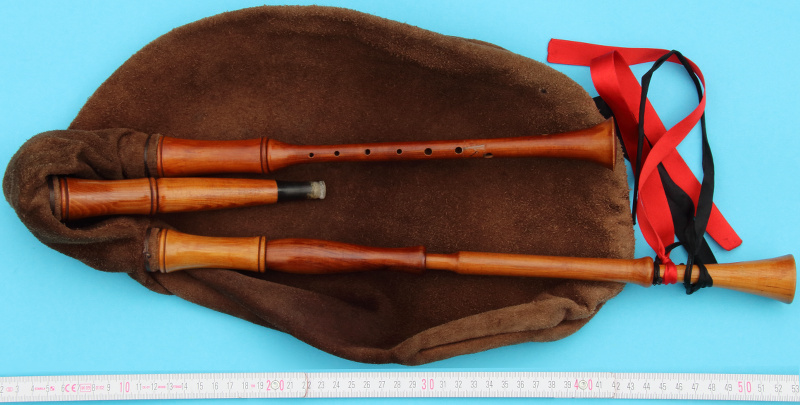
Bagpipe shown here is mouth blown and has a conically bored chanter equipped with a double-reed and one cylindrically bored drone equipped with a single-reed. This bagpipe sounds rather loud despite its small size. It corresponds to a Schäferpfeife (ger., means "shepherd's bagpipe") in physics and sound, but it's plainly designed in difference to most Schäferpfeifes. So this instrument looks very similar like a medieval bagpipe. Its chanter has a scale range of c² d² – e♭³ and is tuned up to tuning pitch a¹ = 440 Hz. Drone is tuned on tone d⁰
and can be tuned on tone c⁰ if it's needed. This instrument can also be used to produce "strange" sounds. If air pressure in bag is increased more or less some overblown tones (g³, a³ and b³ almost stable), some squeaking tones and some intentionally dirty tones can be played.
Wooden parts of the instrument shown above are made of chequer tree wood. The bag is made of leather. This instrument is equipped with plastic reeds.
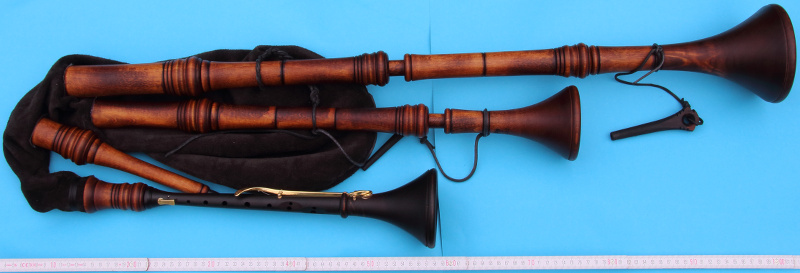
Bagpipe shown here is mouth blown and has a conically bored chanter equipped with a double-reed and two cylindrically
bored drones equipped with single-reeds. This bagpipe sounds very loud. Its chanter has a scale range of f♯¹ – b² and is tuned up to tuning pitch a¹ = 440 Hz. This scale range is extended in comparision to standard scale range g¹ a¹ b¹ – a² of the Marktsackpfeife chanter. Scale range extension is realised with several elements. A key is mounted for tone f♯¹. This key is handled by left little finger. A key is mounted for tone b². This key is handled by left forefinger. Double holes are bored for tones g¹/g♯¹ and a¹/b♭¹. A second thumb hole is bored for tone c♯². This solution voices better than cross fingering for tone c♯². Long drone sounds on tone A, short drone sounds on tone e⁰. Both drones cannot tuned to other tones. Therefore keys/modes can only be played based on keynotes a, d and e. Chromatic scaled chanter gives access to all keys/modes based on keynotes a, d and e. Both drones are used or only long drone is used for playing keys/modes based on keynote a. It's possible but uncommon to use short drone only for playing keys/modes based on keynote a. Both drones are used or only the long drone is used for playing keys/modes based on keynote d. If both drones are used they sound on fifth and major ninth to keynote. This isn't suitable for all tunes and then only long drone is used. Only short drone is used for playing keys/modes based on keynote e. The instrument shown above is equipped with stoppers for both drones to use them separately. A chanter is highly recommended with extended scale range up to tone b² to play keys/modes based on keynote e, because otherwise highest tone of tune is often missing on chanter.
Chanter tube of the instrument shown above is made of blackwood. All other wooden parts are made of stained and oiled maple wood. Chanter bell is stained very dark to meet color of chanter tube. Brass is used for keys. Bag is made of leather. This instrument is equipped with plastic reeds.
|
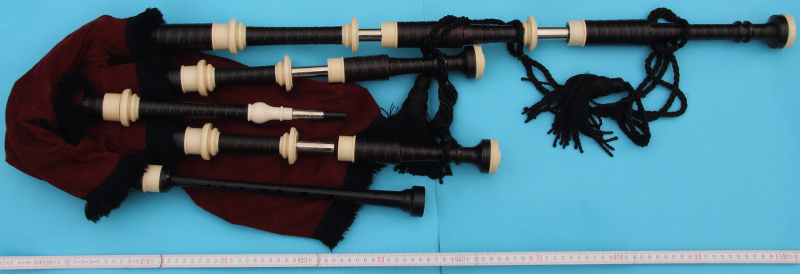
Bagpipe shown here is mouth blown and has a conically bored chanter equipped with a double-reed and three cylindrically
bored drones equipped with single-reeds. This bagpipe is called "Great Highland Bagpipe" (Piob mhor, Cornemuse écossaise, Biniou braz).
Chanter has a scale range of g¹a¹–a². Absolute pitch is c. +120 cent above standard pitch, which
results in a tuning pitch of c. a¹ = 472 Hz. "Bass drone" is tuned on tone A, the two "tenor drones"
are tuned on tone a⁰. This drone configuration is the most conspicuous and most peculiar characteristic of this kind of the bagpipe,
because normally bagpipess only have one drone for each drone tone. A second chanter exists for this bagpipe. This chanter has an absolute pitch
c. +100 cent above the standard pitch, which results in a tunig pitch of c. a¹ = 466 Hz. This is equal to the tone
b♭¹, if equal temperament and standard pitch are used. Tones b♭¹, d♯² and g♯² are problematically on
both chanters. Less this isn't a problem of these tones itself. Problem is caused by very sharp dissonances (minor second, tritone, major seventh;
plus one octave each) those are created through addition of these tones with tones of the two tenor drones, which hardly goes well together with
tonal characteristic of this very loud kind of bagpipe. Wooden parts of the instrument shown above are made of blackwood. Chanter is made of a special plastic (polypenco®). Mounts are made of imitation ivory (synthetic ivory replacement, art ivory). Drones have nickel-slides. Bag is made of cowhide and has a cover made of cord. Drones are equipped with plastic reeds. Both chanters are equipped with a "natural reed" (reed made of the reed "arundo donax"). Absolute pitch of Great Highland Bagpipe (GHB) has gone higher and higher in the course of time. This can be seen in notation for GHB too, because GHB is traditionally notated in a still today. Only nine tones are used on GHB especially in sphere of the military influenced music. These nine tones result in a Mixolydian scale in reference to drone tones. Many musicians think that's a part of tradition of GHB and therefore any other tones shouldn't be played on it. Special names exist for these nine tones. Today these special names are extended to additional tones. Special names are shown in table right. Additional tones are written into gray cells. Limitation to these nine tones also influences notation of "traditional" Scottish GHB music. All this tunes have to be notated with two sharps, but these accidentals are often omitted. If somebody gets such sheets of music and he doesn't now anything about this bad habit, he will hear a very strange and wrong result trying to play this tune. Limitation to these nine tones may be useful in sphere of military influenced music (Pipes & Drums, Pipeband), because additional tones can't usefully produce with each reed-chanter-combination and these tones aren't 100% stable in every case. Limitation to these nine tones isn't useful in most other cases! GHBs are used for traditional Breton music on those at least additional tones minor third (C natural) and minor sixt (F natural) can be played. It may be a disadvantage that some of "traditional" grace notes can't be played on a more or less chromatic playable chanter, but these chanters offer other possibilities for graces. |
|
Bagpipes are known since the antiquity. Instruments similar to Schäferpfeife that's shown above are known in Europe since the late Middle Ages. Similar to the most European music instruments, they have their origin in the orient and were imported by the Moorish people in Spain as well as the crusaders, pilgrims and merchants to Europe.
Four kinds of chanters exist:Some bagpipes have a chanter that's finished with an animal horn (from a cow or a goat) as bell, e.g. all Bocks, Gaide,
Zukra. Some bagpipes are equipped with two chanters. Often oriental bagpipes without any drones are equipped with two chanters, e.g.
Zukra, Tulum. These instruments are normally played unison. Because these two chanters are constructed like a
mijwiz on principle it's possible to play two different parts at one time. Normally two different parts at one time are
played on the European bagpipes with two chanters. Mostly chanter has a scale range of a ninth. Possibilities to play tones that
aren't included in the scale differ from chanter to chanter. Everything is possible from diatonic to fully chromatic. Each chanter of
instruments with two chanters normally has a scale range of a sixth only. Some chanters have a scale range that's extended up to two octaves.
Either chanter is overblown (e.g. Schäferpfeife) or it's equipped with keys instead of fingerholes (e.g. modern Uilleann Pipe).
Number of drones differs from 0 to 6. Mostly one to three drones exist. Normally drones have cylindrical bores and singe-reeds,
but double-reeds are used too, e.g. Hümmelchen, Dudey. Bagpipes those sound loud often have drones that are finished with bells. If
chanter is finished with an animal horn as bell drones are mostly finished with an animal horn as bell too.
Either the air is blown through a blowpipe into bag ("mouth blown") or it's blown with a bellow through a flexible tube into
bag ("bellow blown"). A non-return valve impedes that air can flow back. Constant air pressure that's needed for
chanter(s) and drone(s) is controlled with arm that holds bag.
Chanter(s) and drone(s) are normally manufactured out of wood. Chanters and drones of antique and oriental bagpipes can be manufactured
out of hollow plantstalks (mostly bamboo). Today some chanters are manufactured out of special plastics especially for the Great Highland
Bagpipe. Bag is normally manufactured out of leather. Sometimes hairs are leaved on its skin, e.g. Gaide. Today some bags are
manufactured out of special synthetic materials. Rubber ins't absolutely suitable for bags of mouth blown bagpipes, because humidity blown into bag can't sufficiently be drained off!
 Shawm |
 Top |
 Main page |
© Sönke Kraft, Hannover 2001 last update: 25.10.2015 |