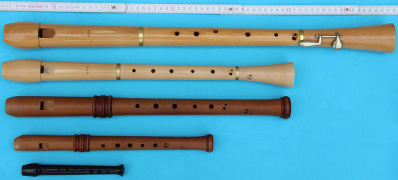
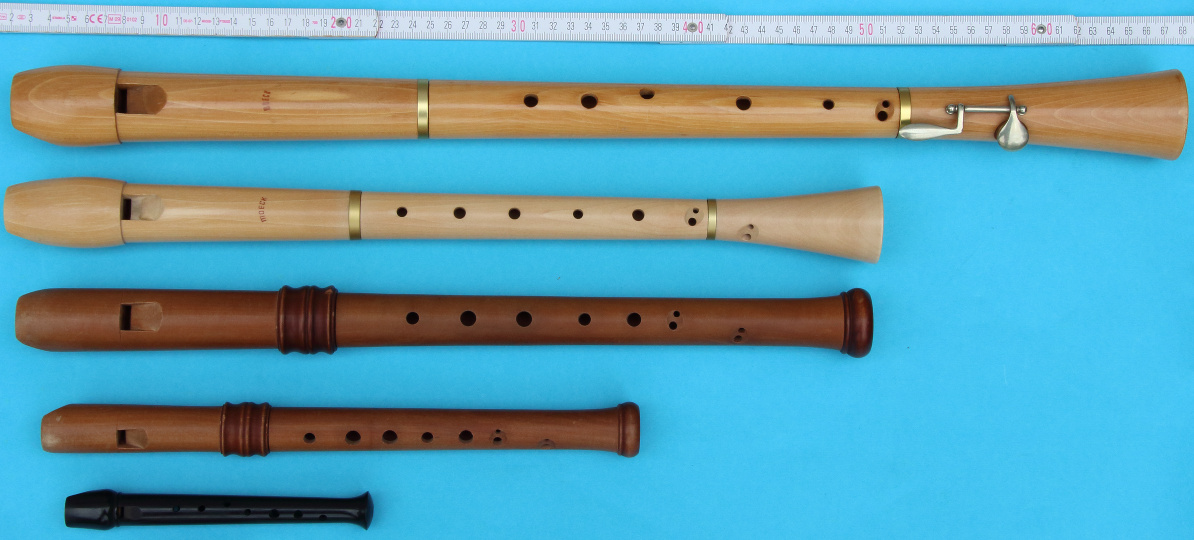
recorders, f. t. t. b.:
tenor in c, alto in f, alto in f, soprano in c, garklein in c
300 dpi JPEG

Hier geht's zur deutschsprachigen Version
Go here to the German version
recorders, f. t. t. b.: tenor in c, alto in f, alto in f, soprano in c, garklein in c 300 dpi JPEG |
Recorder | Hier geht's zur deutschsprachigen Version Go here to the German version |
The recorder is a beak flute with a narrow flue and a sharp slit. Recorders have eight fingerholes including a hole for left thumb. Cross fingerings
can be used and they are required to play in overblowing range. Recorders only have a small range to slide tones. Fingerholes for the two lowest tones are constructed as double-holes since the Renaissance to play recorders fully cromatic. Some keys were introduced in this aera as well to handle large instruments. Recorders mostly produce a gentle and restrained sound that's sometimes
a little bit dull or smoky too. However solo instruments often sounds more powerfully. Scale range is about two to three octaves whereby
recorders are overblown up to three times. Recorders overblow at first time into the octave, at second time into the twelfth and at third time into
the fifteenth. Lowest tones can be overblown into higher ranges on larger instruments. This enables to use these instruments as a kind of
natural tone flute. Using special blowing techniques enables to play some intentional dirty tones.
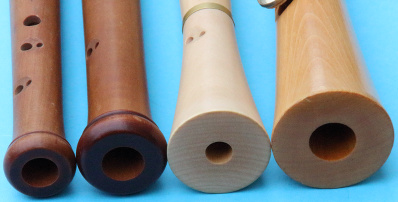
Two different bore kinds exist. Bore means taper of instrument's tube downwards. Instruments were build with minor taper of instrument's tube downwards until the Renaissance. Smaller instruments had a cylindrically bored tube until the Renaissance. These wide-bore recorders often called "Renaissance recorders" although smaller sizes were already build in the Middle Ages. Wide-bored recorders sounds fundamental. They sound well together and in combination with other instruments of the Renaissance. Sound of wide-bored recorders may be too little present for solos depending on accompaniment. Instruments were build with major taper of instrument's tube downwards since the Baroque. These narrow-bored recorders often called "Baroque recorders". Narrow-bored recorders sound more presently and more richly in overtones than wide-bored recorders. Therefore narrow-bored recorders are very suitable for solos. Difference between wide-bored and narrow-bored shrinks on large instruments from bass recorder and deeper sounding recorders, because their constructions depends on other parameters, especially air flow (volumetric flow rate). Nowadays some wide-bored recorders are build those sound with a carrying tone. These wide-bored recorders are suitable for solos too, but their sound differ from sound of narrow-bored recorders. Another modern version of recorder uses a square cross section instead of a circular one. Required air flow is determined by a hole that's located lateral at lower end of tube. These instruments are build in sizes tenor and larger. Building of these instruments is much simplified by replacing a bored tube with a square frustum made of plywood. The two deepest instruments are only build in this version. The third deepest instrument is often build in this version too.
Recorder-like instruments belong to the oldest instruments of the world. They are already documented in prehistoric time with artifacts. The recorder itself is known since the 11. century in Europe in her modern kind (without keys). It is build in imitation of vocal quartet with soprano, alto, tenor and bass as a whole family since the Renaissance like the most instruments of this aera. Higher and lower sounding instruments are build too. Today most recorders are build in c/f-pitch but instruments in other pitches existed and still exists too. Recorders in c/f-pitch are listed below:
| garklein in c | lowest tone c³ |
| sopranino in f | lowest tone f² |
| soprano in c | lowest tone c² |
| alto in f | lowest tone f¹ |
| tenor in c | lowest tone c¹ |
| bass in f | lowest tone f⁰ |
| great bass in c | lowest tone c⁰ |
| contrabass in f | lowest tone F |
| sub-bass in c | lowest tone C |
| sub-contrabass in f | lowest tone F₁ |
All sizes are used to date. Normally smaller sizes from garklein to tenor are used as solo instruments. Soprano, alto, tenor and bass recorders form the typical recorder quartet. It sounds an octave higher than written. It's like a 4′-rank of a keyboard instrument in this point. Therefore it's also called 4′-choir. A recorder quartet with tenor, bass, great bass and contrabss recorders sounds an octave lower and it's called 8′-choir. Another recorder quartet is possible with garklein, sopranino, soprano and alto recorders. This recorder quartet sounds two octaves higher than written, but this 2′-choir is very uncommon. If a 4′-choir is used sometimes a sopranino or garklein recorder doubles soprano recorder part an octave above soprano recorder and a contrabass recorder or a double-reed instrument (bass cornamusa, bass crumhorn, bass curtall, bass sordun, bass rackett, …) bass recorder part an octave below bass recorder in larger ensembles. 4′-choir and 8′-choir are also played together. This doubles all parts in octave intervals.
Nowadays the term "recorder" is used as a negative term for cheap soprano recorders of inferior quality those are produced in
mass production since the second half of the 20. century. These "instruments" normally sound so horrible that you can
effectively spoil every humans fun on handmade music.
 Mijwiz |
 Mandolin |
 Top |
 Main page |
© Sönke Kraft, Hannover 2002 last update: 25.10.2015 |